
11 Plus Pass Marks and Qualifying Scores by Area
Compare published 11+ qualifying scores by area, with official sources. Understand why raw percentages, qualification rules and the last score offered a place are different.
 Elspeth Marlow
- 13 min read

There is no national 11+ pass mark. A raw percentage such as 70% or 80% does not identify a qualifying result unless the admissions authority publishes that rule for the particular test and entry year.
Many selective areas use age-standardised scores, but their scales and allocation rules differ. Buckinghamshire's 121, the Lincolnshire total of 220 and the CSSE minimum of 303 are not interchangeable. Some authorities state a threshold before the test; others set it after marking. Meeting it still does not guarantee a school place.
This guide separates published qualification rules from offer cut-offs and links to the authority or school behind each example. Always check the entry year, score scale and oversubscription rules on your own results letter and determined admission arrangements.
Is 70% enough to pass the 11+?
A practice-paper percentage tells you how many available marks your child earned on that paper. It does not, on its own, tell you their official standardised score or whether they would qualify in a particular area. Where an authority publishes a conversion method, use it only for the paper and cohort it describes.
The practical consequence is that the same 70% can produce very different outcomes:
- A younger child in the year group gets a larger age adjustment than an older one, so two children with identical raw marks can end up several standardised points apart.
- A paper that the whole cohort found difficult will convert 70% into a higher standardised score than an easy paper would.
- The threshold that standardised score is measured against is set locally, so it differs from county to county and can move from one entry year to the next.
So the question "is 70% a pass" cannot be answered, but a better question can be. Ask instead: what standardised score does my area require, is that figure fixed or set annually, and how many children typically reach it? That is a question with real answers, and the rest of this guide supplies them.
Why there is no national 11 plus pass mark
There is no national pass mark because there is no national 11 plus. Selective admission survives in around 36 English local authority areas plus a scattering of individual schools, and each of those areas designs its own arrangements. Test formats differ, subject weightings differ, and the body that sets the threshold differs.
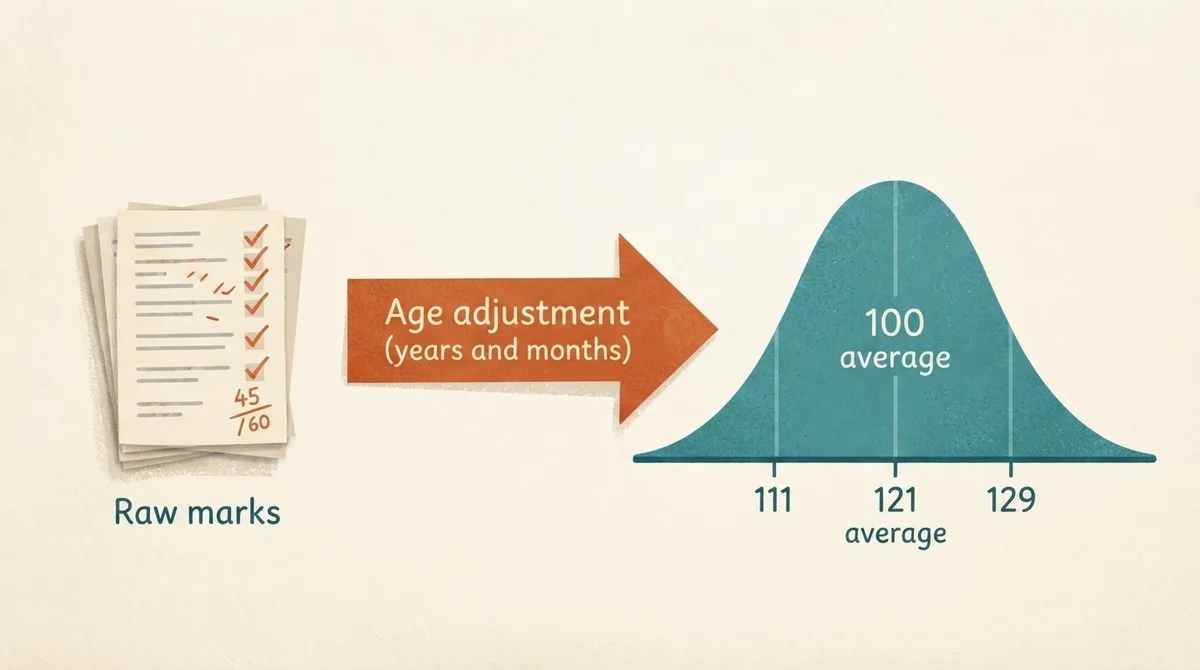
GL Assessment, whose papers are used across much of the country, is explicit that it supplies the assessment rather than the cut-off. Its guidance describes a Standard Age Score as a conversion of a pupil's raw score into a standardised score that takes account of the pupil's age in years and months, with an average of 100. What counts as qualifying is then decided by the local authority, the consortium or the school's own trust.
That is why the weightings vary so much. Buckinghamshire builds its Secondary Transfer Test Score from 50% verbal skills, 25% mathematical skills and 25% non-verbal skills. Bexley uses the same 50/25/25 split across verbal, numerical and non-verbal. Medway weights its papers English times two, Mathematics times two and Reasoning times one. Essex, through the CSSE, uses only English and Mathematics, each worth 50%. Four areas, four different definitions of a total score, and therefore four incomparable thresholds. If you want the format detail behind these, our guide to the 11 plus exam covers what each area actually asks children to sit.
11 plus qualifying scores by area, with sources
Every figure below was read on the official page cited beside it. Where a number in wide circulation disagrees with the official page, we say so.
Buckinghamshire: 121. The council states that if a child's Secondary Transfer Test Score is 121 or above, they qualify for grammar school. Standardised scores fall between 60 and 170, and around 37% of children are expected to score 121 or above. The page was last updated on 9 April 2026. Source: Buckinghamshire Council, marking the Secondary Transfer Test.
Kent: 332 total, with no single score lower than 108 (2025 threshold). Children receive three standardised scores, in English, maths and reasoning, plus an aggregate. For the 2025 threshold, a grammar school assessment required a total of 332 or more with no single score below 108. Individual scores range from 69 to 141, and the highest possible total is 423. The 2026 threshold is due in October 2026. Source: Kent County Council, Kent Test results.
Correction worth noting: Atom Learning, the page most prominently cited in Google's AI Overview for this query, states the minimum single score as 109. Kent's own page says 108. Where a tuition site and a council disagree about the council's own threshold, use the council. There is more Kent-specific detail in our Kent Test guide.
Medway: 481 for 2026 admissions. Medway sets a minimum total weighted score every year. Recent figures are 481 for 2026 admissions, 482 for 2025 and 492 for 2024. The tests are designed to assess the equivalent of 26% of children attending Medway maintained schools as suitable for grammar. Source: Medway Council, the Medway Test.
Lincolnshire: 220. Answering "what is the pass mark" directly, the Lincolnshire Consortium of Grammar Schools states that the qualifying level is a total standardised score of at least 220 across both papers. The Consortium also notes that the tests identify potential rather than attainment, may be taken only once in an academic year, and that raw scores are not released to parents. Source: the Lincolnshire Consortium selection process FAQ at grammarschools.lincs.sch.uk.
Bexley: no fixed pass mark. All children who take the test are ranked in order of their total age-standardised score, and the council, together with the four grammar schools, then determines the selective score. The average total weighted age-standardised score is 200, with roughly two-thirds of candidates scoring between 170 and 230. In 2025, 5,866 children sat the test, 2,070 reached the selective standard, and 800 grammar places were available. Source: Bexley Council, about the selection test.
Essex (CSSE): 303 minimum, but not a guarantee. The CSSE Information Guide for 2027 entry states that offers are not made to any child scoring under a total standardised score of 303, with successful appeal places awarded outside that criterion. The same guide is careful to add that the actual cut-off scores are only known after national offer day in March, and that there is no guarantee of a place based on historical information. Candidates sit English and Mathematics, each sixty minutes, with ten minutes additional reading time for English.
King Edward VI schools, Birmingham: 205 qualifying, 224 priority. The academy trust board determined that the qualifying score for entry in September 2025 would remain at 205, with a priority score of 224. This is a useful example of an area using two distinct thresholds: one to qualify, and a higher one that carries priority in the allocation of places.
How to read the table: fixed thresholds versus annually set cut-offs
The figures above look like the same kind of thing. They are not, so check which decision each figure describes.
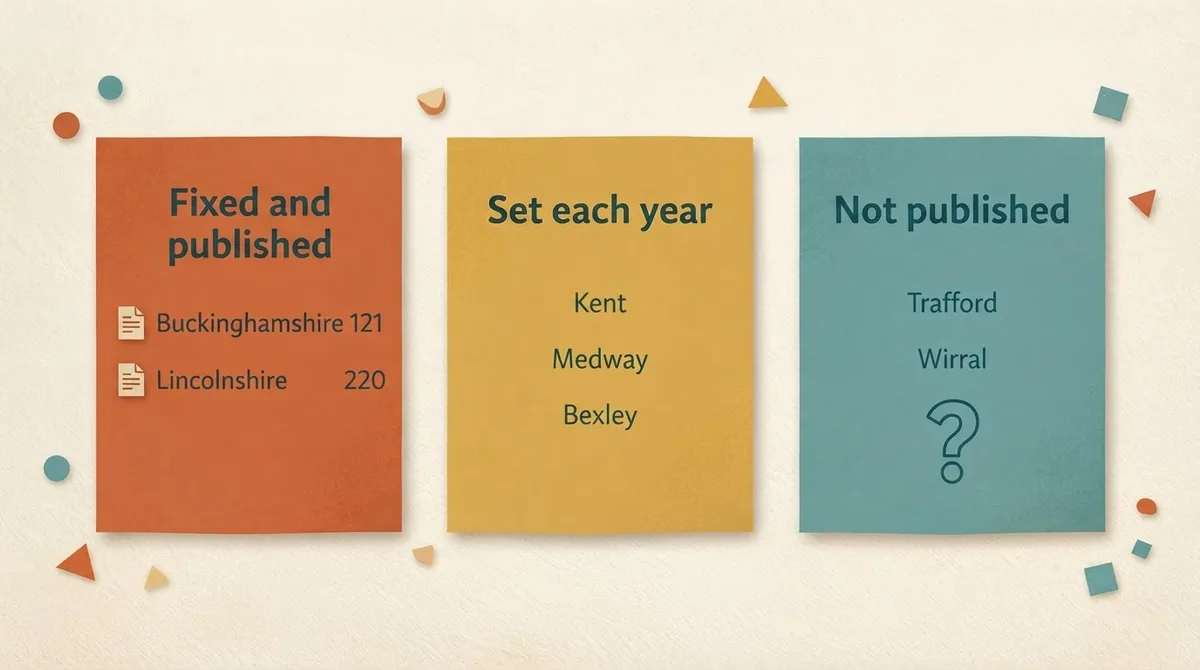
Published-in-advance thresholds are stated before the test for a named entry year. Recheck each new policy rather than assuming they never change. Buckinghamshire's 121, Lincolnshire's 220, the CSSE minimum of 303 and King Edward VI's 205 all sit here. You can prepare against them, because the authority has told you the number before your child sits the test.
Annually set or ranked cut-offs work in the opposite direction. Bexley ranks every candidate and then decides the selective score. Medway sets a minimum total weighted score each year, which is exactly why it has moved from 492 to 482 to 481 across three admission rounds. Kent publishes its threshold in October, after the tests have been marked. In these areas the pass mark is an output of the cohort, not a target set in advance. Quoting last year's number as though it were this year's is the single most common error on this topic.
That distinction matters for how you prepare. Against a fixed threshold, you are aiming at a stated bar. Against a ranked cut-off, you are competing with the children who happen to sit the test in the same year as yours, which makes consistent performance across full papers more informative than any single score. Timed mock tests under exam conditions are the closest proxy families have to that.
Check school policies as well as the council overview
A council's general entrance-test page may omit a figure that appears in a school's own policy or in the determined arrangements. Absence from an overview is not evidence that no official threshold exists.
Stretford Grammar School: 334 for 2027 entry. The school's admissions page publishes that qualifying score and says that it is not an offer of a place. It reports one standardised score without a breakdown. Check each Trafford consortium school's own qualifying and oversubscription rules; do not treat one school's figure as a rule for every school.
Redbridge: minimum threshold of 104 for 2027/28. Paragraph 2.12 of the council's determined admission arrangements states that applicants below 104 are not added to the ranked list or waiting list. Above that floor, the policy's priority categories and ranking still decide allocation. A minimum threshold is not the score of the last child offered a place.
Where a page does not give a numerical threshold, read the determined policy and results guidance before concluding that the number is unpublished. Registration, test qualification and the school application are separate steps.
How standardised scores work, and why percentages are the wrong unit
Standardisation does two jobs. First, it adjusts for age, so that a child born in August is not penalised against a child born the previous September. Second, it puts marks on a reference scale for that test. Single-paper scales, weighted composites and added totals can use different numbers, so check which result your authority reports.
A worked example, using invented numbers to show the mechanism rather than to predict anything: imagine two children each score 42 out of 60 on the same reasoning paper, which is 70%. One is 10 years 2 months old at the time of the test, the other 11 years 1 month. After the age adjustment, the younger child's standardised score comes out higher, because the same performance from a younger child is more unusual. Whether raw marks or a breakdown are also reported depends on the authority. Use the score and rule specified on the official result.
This is also why score conversion tables published by tuition companies should be treated as illustrations, not lookups. Use a conversion only if the relevant authority publishes it for the exact paper and cohort. CSSE publishes named annual reports; those are different from guessed GL conversions or a previous year’s coefficients applied to a new paper. Understanding which board your area uses helps here, and our comparison of GL, CEM and ISEB explains how the marking differs.
Our 11+ score calculator by area uses published methods and thresholds. It explains when you need a reported score rather than a raw mark. Guessed cohort statistics cannot predict an official GL result.
What counts as a good 11 plus score?
A score only has meaning on the scale used for that test. Buckinghamshire publishes 121 as its qualification rule. You cannot apply that rule to Bexley’s different scale or to the CSSE combined total.
Check three things on the official results letter and school policy:
- Is this a component score, a weighted score or an added total?
- What qualifying rule applies to the same test and entry year?
- Does the school rank qualified applicants by score, distance or other priority criteria?
There is no general rule that 111, 121 or 129 secures a place across areas. Use a reported percentile only if the provider supplies it for that particular assessment. Tracking progress over time on comparable practice is a separate task from interpreting an admissions result.
Qualifying does not mean a place
Reaching the qualifying standard entitles your child to be considered. It does not entitle them to a place. Bexley's own 2025 figures make the point plainly: 2,070 children met the selective standard, and there were 800 grammar places available. Wirral says the same thing in words, noting that oversubscribed schools use other criteria to decide who is offered places. The CSSE adds that actual cut-off scores are only known after national offer day in March.
Kent spells out the consequence for families who apply anyway. If a child is not assessed as suitable for grammar, you can still name a Kent grammar school on your application, but that application will be refused when places are offered on 1 March 2027, with a right of appeal.
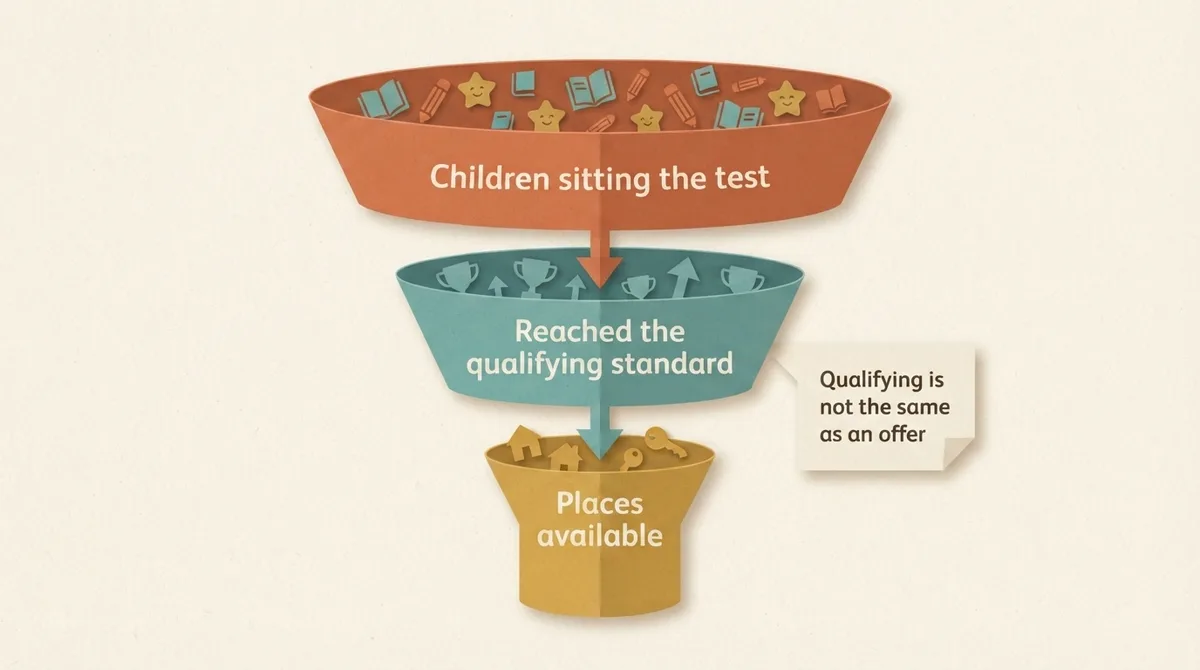
So the sequence is: sit the test, receive a standardised score, be assessed against a threshold or a rank, then enter the general admissions round where distance, siblings and other published criteria apply. Build a preference list that works at every stage, not just the first one.
When these numbers change and how this page is maintained
The annually set thresholds land in autumn. Kent emails results on Thursday 15 October 2026 and will publish its 2026 threshold in October 2026. CSSE candidates for 2027 entry sit on Saturday 19 September 2026 with results emailed on 12 October 2026. Medway sets a fresh minimum weighted score each admission round.
Check the entry year beside each figure and follow its official source. Thresholds and last-offer scores can change, and the latest result may not be available yet. A missing figure stays unknown; it is not a reason to estimate one. If you are working out where your child currently stands against a real paper rather than a rumour, you can start a free account and use full-length papers in your area's format.
11 plus pass mark FAQs
Is there a percentage pass mark for the 11 plus?
No. No local authority or consortium we checked publishes a percentage threshold. Thresholds are published as standardised scores, because raw percentages do not account for age or paper difficulty.
Why do so many sites say 80%?
It is a figure that has been repeated between tuition sites until it acquired the appearance of a fact. It does not trace back to a primary source. Ask any page quoting a percentage which authority publishes it.
What is the highest possible 11 plus score?
It depends entirely on the area, because totals are constructed differently. In Kent, individual scores range from 69 to 141 and the highest possible total is 423. In Buckinghamshire, standardised scores fall between 60 and 170.
Can my child retake the test if they miss the threshold?
Generally no within the same admissions round. Lincolnshire, for example, states that its tests may only be taken once in the academic year. Some areas operate a review or appeal process instead, which is not the same as a retake.
How should we prepare if our area does not publish a pass mark?
Focus on full-paper consistency rather than a target number. Where cut-offs are ranked or unpublished, repeated timed practice under real conditions, using mock exams in the correct format, is a better guide than any score you can look up.
Topics
- 11 plus
- pass marks
- standardised scores
- grammar schools
- admissions